“With the 5th pick the 2017 NFL Draft the Tennessee Titans select Corey Davis, wide receiver from Western Michigan.”
Goodness, it feels like ages ago when Roger Goodell said those words. Honestly, it’s a little unfair all the expectations Corey Davis has faced since being selected so high. Julio Jones’ name was floated around as the standard far too easily just because of draft position.
We knew Corey Davis wasn’t Julio Jones coming out, but the value associated with the fifth pick in the draft led to where we are today. So far, we don’t know precisely how good Corey Davis is – this article will attempt to answer that.
He doesn’t look like a Julio Jones caliber player and the Titans offense doesn’t cater to explosive plays or racking up receiving yards.
You can hear the discussion Turron Davenport and I had on this topic from last week’s Talking w/ TD. Every week I bring an analytical topic to the table for Turron’s outstanding podcast, and this article is a branch off from that.
So… how do we evaluate Corey Davis?
Let’s start with the Titans offense. Frankly, they didn’t do him many favors last year. Marcus Mariota was hurt, Blaine Gabbert struggled, there were many times where they were too committed to running the ball, etc. The eyesore that has been the Titans’ offense is well documented.
Per SharpFootballStats, they were next to last in passing percentage for the entire NFL. They struggled to rack up on total plays, it’s hard to score if you aren’t snapping the ball very much. They were 23rd in the NFL in net yards per attempt, per ProFootballReference. This all shows the poor state of the Titans passing offense in 2018.
All of this makes life very difficult on a receiver, no matter how talented.
So what did Davis do with all of this last year?
He played in all 16 games, caught 58% of his passes (161st in the NFL), totaled 891 receiving yards (25th) on 8 yards per target (56th). Not mind-blowing right? Lots of volume, yards per target doesn’t tell you much and he was generally inefficient.
Let’s take a look at it through the almighty graph. This data comes from the NFL’s NextGenStats, it uses catch percentage (self-explanatory) and targeted air yards.
NextGen defines targeted air yards as, “The average passing air yards per target for the receiver, by measuring the yards downfield at the time of all passing attempts that the receiver is the target. This stat indicates how far down the field they are being targeted on average.”
The last sentence sums this up very well, how far down the field a player is when the ball is thrown to them.
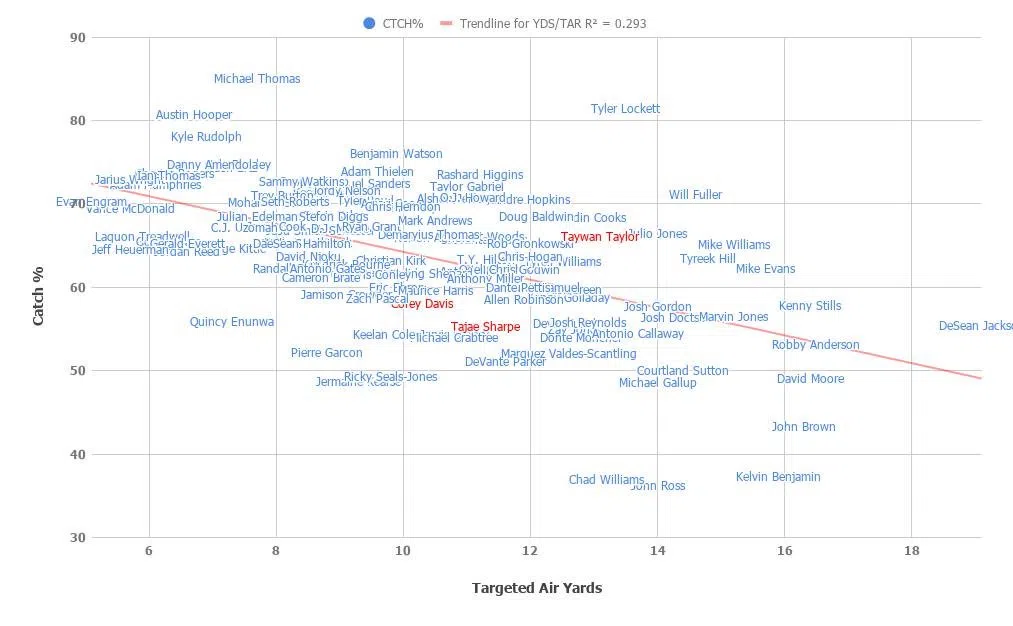
Looking at Davis in this light turns up a below-average result. There’s a strong trade-off between throwing downfield and catching a high percentage of passes. Davis turned out to be a below-average receiver for the average depth of each throw to him. Interestingly, this makes a compelling case for Taywan Taylor but he’s not the focus of this article.
If the Titans want to maximize Davis, first quarterback play must improve. Second, he must stretch the field like the best receivers do. This can mostly be attributed to scheme, though.
So how can we use any stats to look at what Corey Davis is or what he can become?
The baseline used for measuring success in the following graphs is a rough metric to quantify overall success. Using well-known stats everything can be compiled into one metric called the “success score”.
The success score isn’t the crowning achievement of my career, but for these purposes it suffices.
I haven’t painted a nice picture of Davis so far, but things will turn around now. Take a look below.
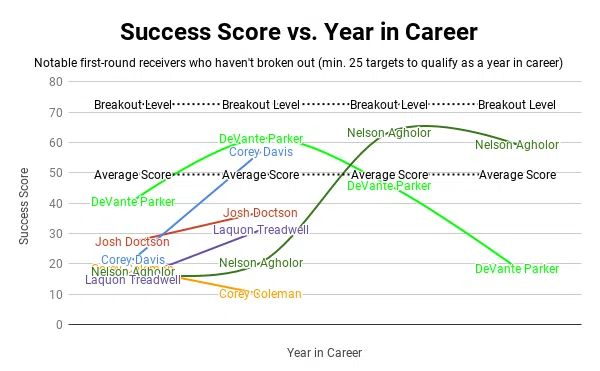
In year one of his career Davis could be grouped with the likes of Josh Doctson, Laquon Treadwell and Corey Coleman. Yikes. All posted well below average success scores due to poor cumulative and rate statistics.
However, Corey Davis far outperformed these “bust” receivers in his second qualifying season. (To qualify as a season a receiver must have 25 targets)
Davis went from bottom of the barrel to above the average! It took Nelson Agholor an extra year to do that, and he turned out to be a solid wideout. Davis far exceeded what other notable first-round receivers did in their second qualifying seasons.
This ought to encourage anyone who fears Davis is a “bust” because so far he has outpaced some bad receivers.
Now what about receivers who turned out to be pretty good, how does Davis compare to them?
Well, several top receivers broke out before their third year. So, to create fair comparisons let’s look at some high-level receivers who didn’t achieve a “breakout” level score until after their second qualifying season.
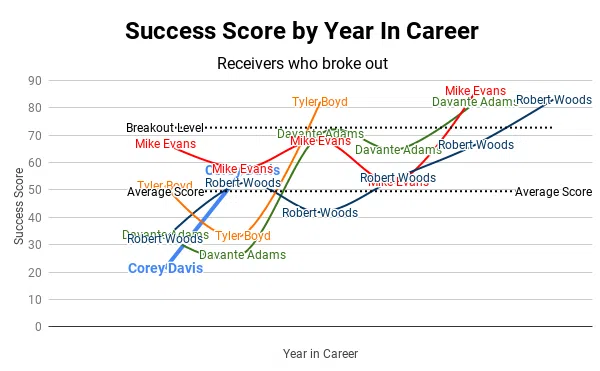
This one is a little bit cluttered, but we still see Davis make a jump in year two that most others didn’t. We see Tyler Boyd and Davante Adams regress from year one to year two (be sure to note health concerns).
Overall what you can take from this is how it took some guys a little extra time to become very good NFL wide receivers. Mike Evans was always good, but Boyd and Adams developed over a few seasons.
With Davis’ showing in year two, it’s feasible to believe a high-level NFL career is in the tank. Health held Adams and Boyd back in the beginning, just like Davis in year one. They’re proof a rebound is possible.
He needs help from Marcus Mariota and Arthur Smith this year. If Arthur Smith can marginally improve the Titans passing attack Corey Davis is certainly in line to benefit from it.
Robert Woods is a perfect example of success in a better offense. I know the Titans probably won’t get Sean McVay level improvements, but with some help Davis’ talent can make him more of a threat than Woods.
I’m certain Davis will be featured in this Titans offense, unless Jon Robinson intended to waste the fifth overall pick.
All of this to say, the development path is there for Corey Davis.
This has significant fantasy implications for his draft stock. If you’re a fantasy football player, take a look at Davis as your WR2.
Last season he was the 27th highest scoring wideout (per ProFootballReference), and with the pieces coming together he’s worthy of a consistent spot in your lineup.
This is an important year for Davis. We saw flashes in year two, but for his trajectory to stay positive he needs to be more efficient. This goes hand-in-hand with the Titans’ past schematic issues. Neither the Titans nor Corey Davis can fix their production problems without each other.
How do the Titans improve their passing woes? Stay tuned to TheGameNashville.com as I’ll be uploading more articles throughout the preseason.
If you have any questions or concerns, get at me on Twitter @SmithACalvin. My DM’s are open for you to say anything you hate or love about this article. If you have a story idea, feel free to hit me up.